
Descrição
Sell.AI Stock lets a WooCommerce store sell the same product from several warehouses or suppliers. Each warehouse has its own stock and, optionally, its own price.
Store
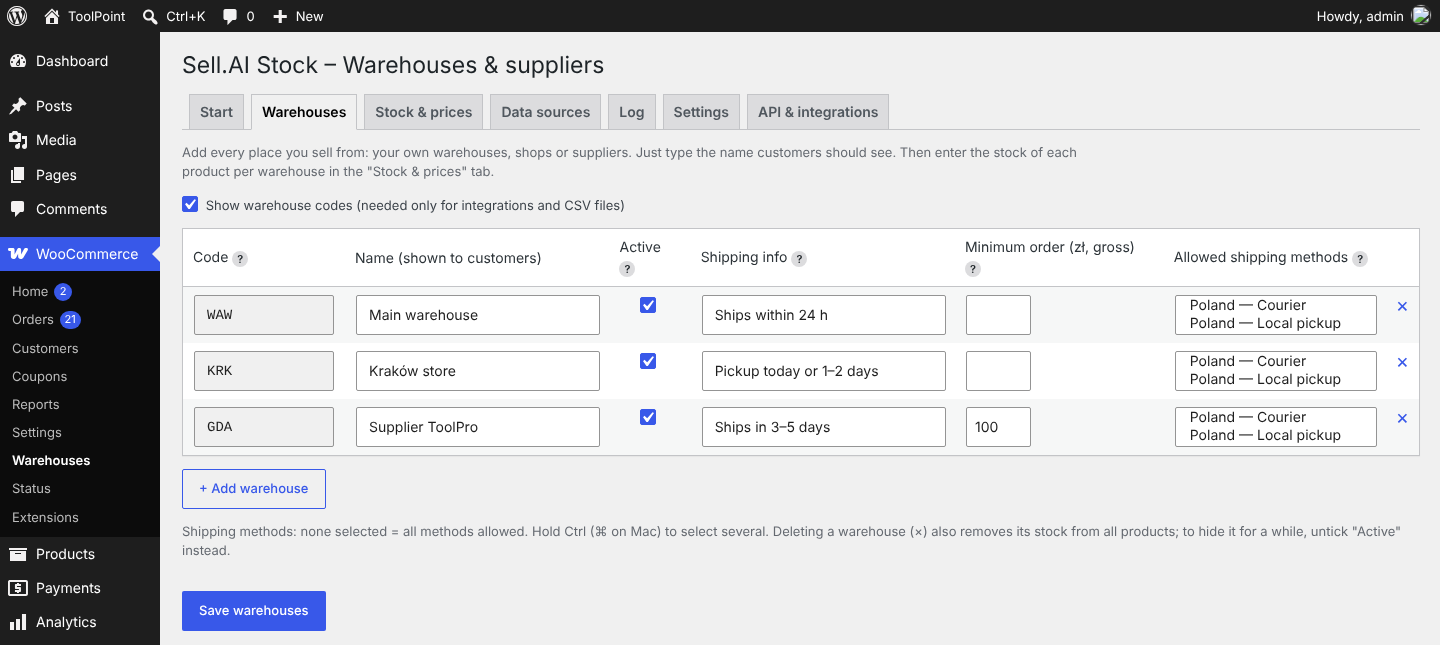
- Central warehouse registry with name, shipping info, minimum order value and allowed shipping methods.
- “Stock & prices” table: all products and variations in one editable grid (stock and price per warehouse), with search, filters, paging, conflict detection and saving of changed rows only.
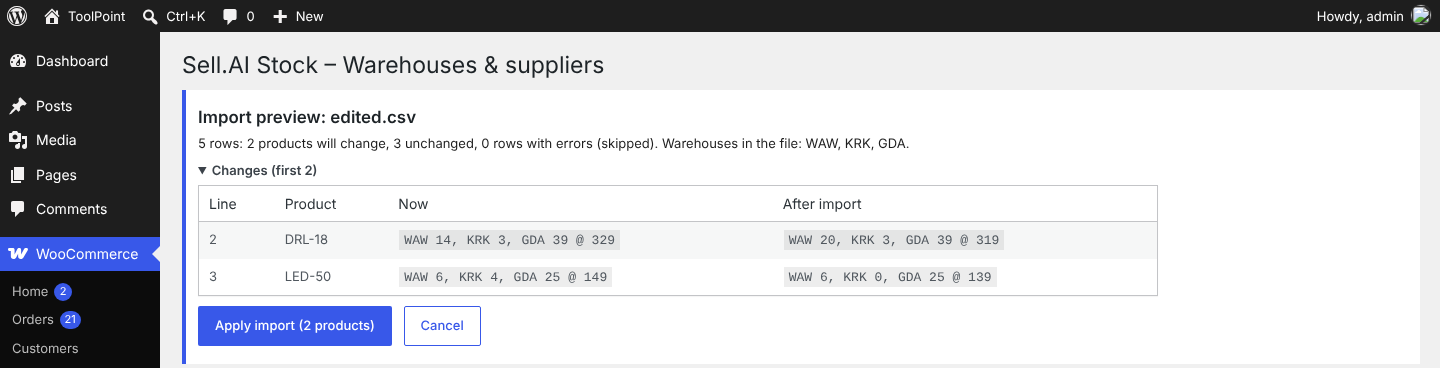
- CSV export and import of stock and prices (Excel-friendly), with a preview of every change before it is applied.
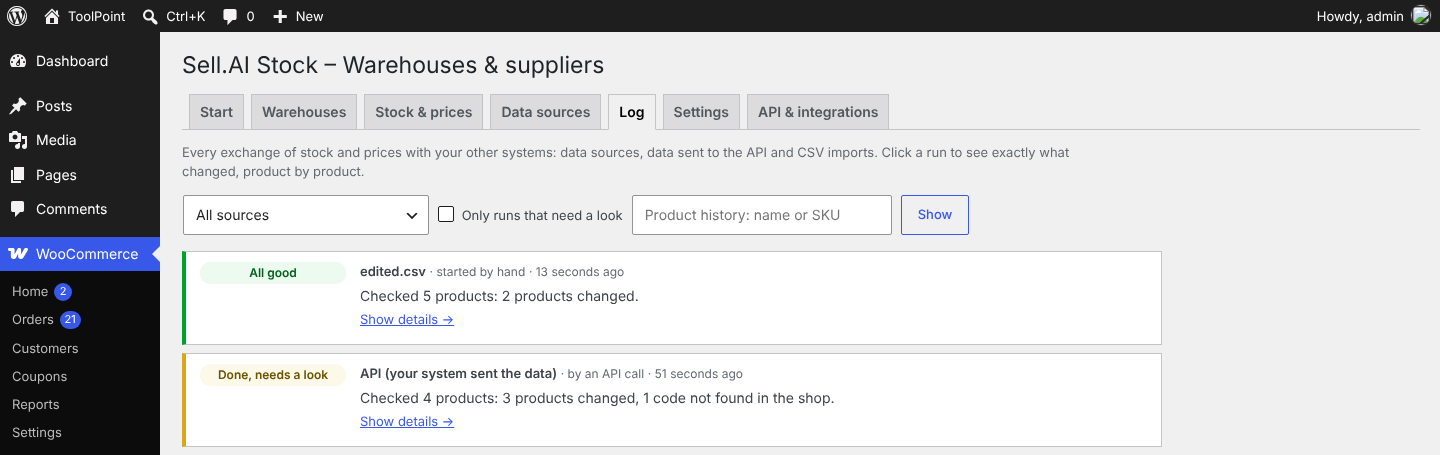
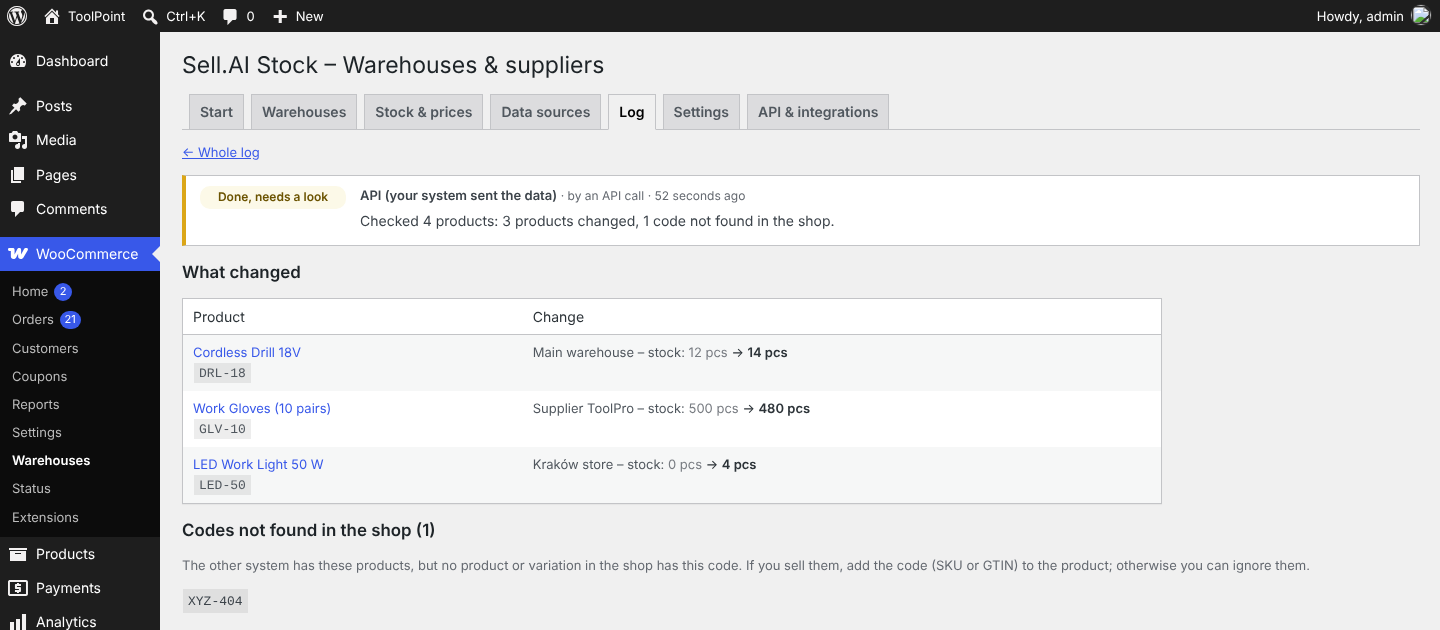
- Data exchange log in plain language: what changed, product by product, and what to do about problems.
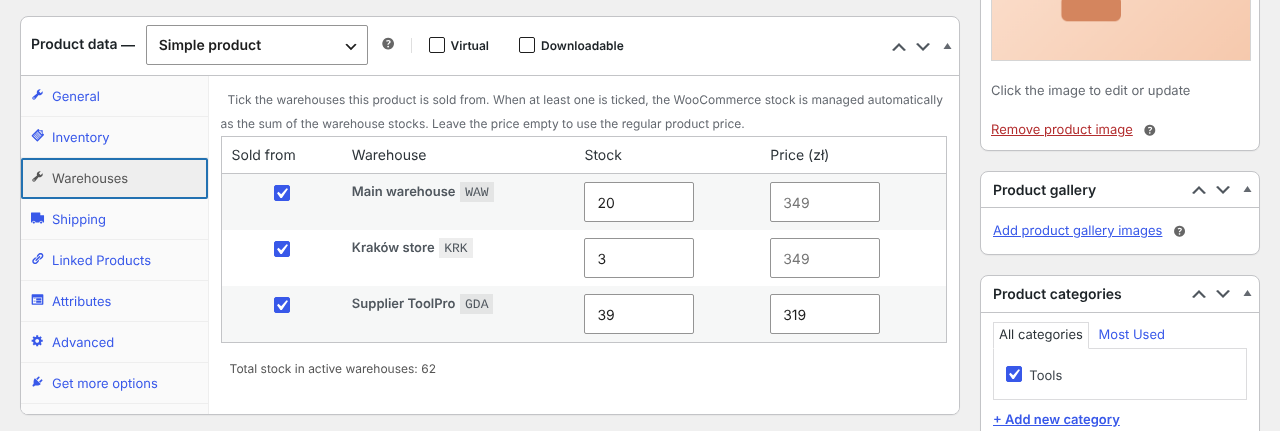
- “Warehouses” tab in the product editor and a warehouse table in every variation. The WooCommerce stock is kept equal to the sum of the warehouse stocks.
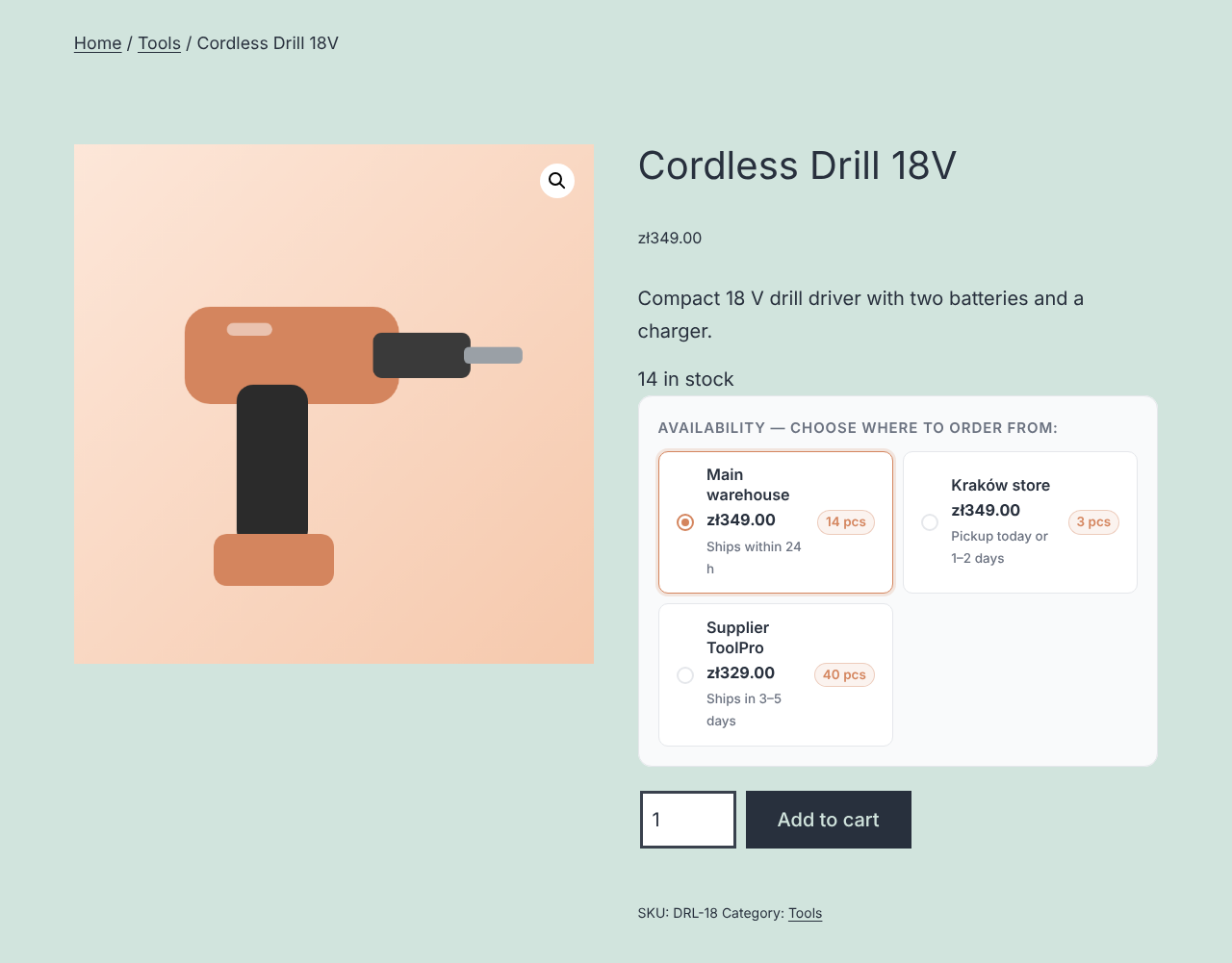
- Warehouse selector on the product page in 5 styles (cards, compact list, buttons, drop-down, minimal), with accent colour and corner settings, plus a warehouse picker for product tiles.
- Automatic warehouse assignment when the customer adds a product without choosing (first warehouse with stock, or the cheapest one).
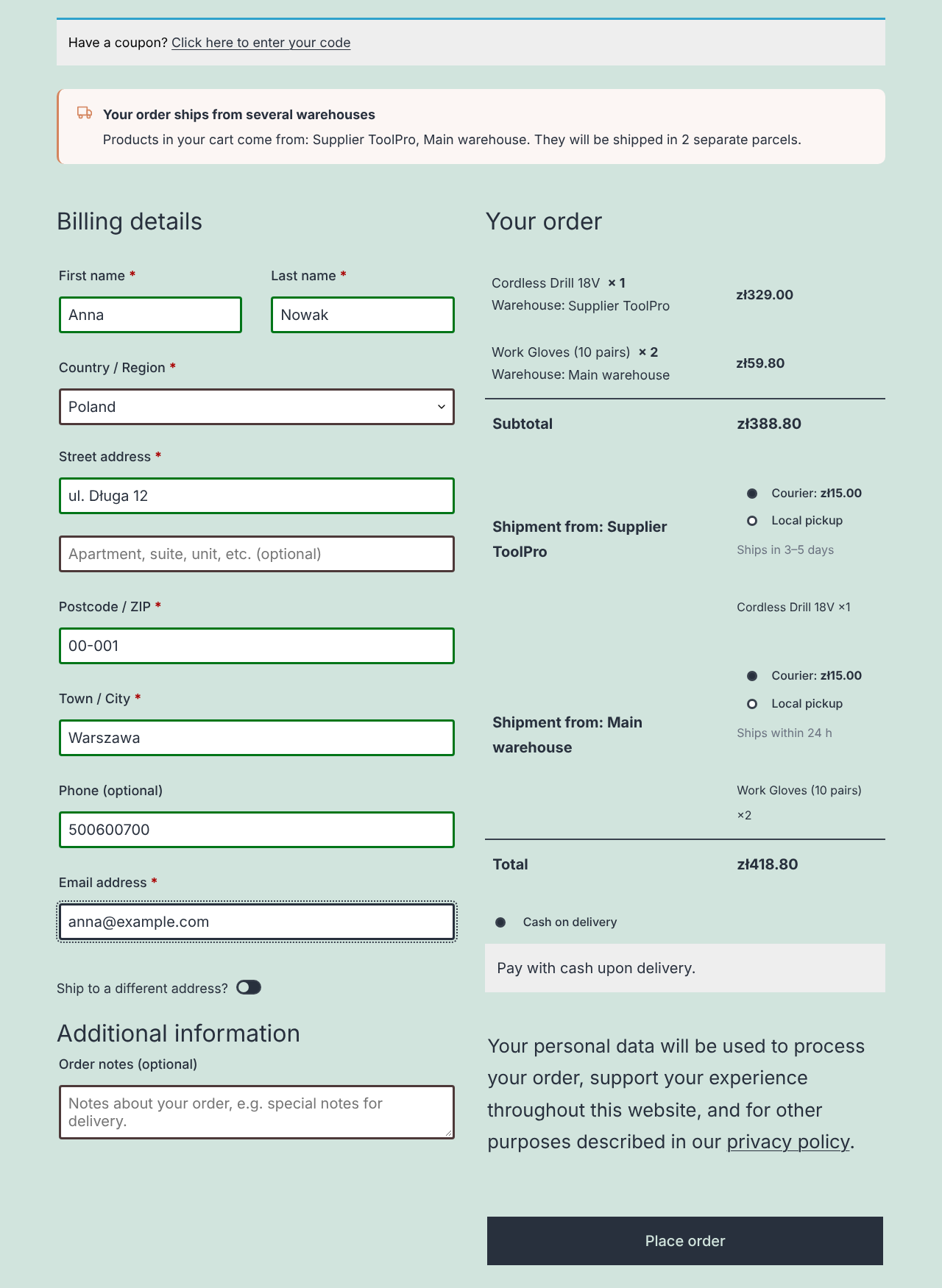
- The same product from different warehouses becomes separate cart lines with per-warehouse prices. The customer can change the warehouse in the cart.
- One shipping package per warehouse, with per-warehouse shipping methods and minimum order values.
- The warehouse is shown on order lines, in emails and in the admin. Warehouse stock follows the order: placed, cancelled, edited in wp-admin, refunded with restock. You can change the warehouse of a line in the order editor.
- Classic and block cart/checkout. Works with any theme through standard WooCommerce hooks. Compatible with HPOS.
Integrations
- Authenticated REST API (
/wp-json/sell-ai-stock/v1/) with bulk, idempotent upsert of stock and prices by SKU or product ID, dry-run mode and out-of-order protection. - Deny-by-default authentication: hashed API token in a header, or a user / application password with the
manage_woocommercecapability. - Per-warehouse stock in the standard WooCommerce REST API (products, variations, batch, order lines).
- WP-CLI commands (sync from a JSON file, CSV export and import). Filters and actions for custom adapters. The full API reference is in README.md.
Sell.AI Stock Pro (paid add-on)
Everything above is free and complete. The separate Sell.AI Stock Pro add-on (sold on trysellai.com) adds automatic updates from other systems:
- Base (Baselinker) connector: choose the catalog, warehouses and price groups from lists.
- Wholesaler files (XML, CSV, JSON) with field mapping and a schedule.
- Compatibility mode for the official Base integration.
- Signed outgoing webhooks for stock changes and orders.
The “Data sources” tab of this plugin shows what the add-on does when it is not installed. Nothing of the add-on is included in this plugin.
External services
This plugin does not connect to any external service and sends no data anywhere. Other systems can send stock to the shop through its REST API; that happens only when the store administrator creates an API token and gives it to such a system.
The “Data sources” tab links to the page of the Sell.AI Stock Pro add-on on trysellai.com; nothing is loaded from that site.
Capturas de tela



Instalação
- Upload the plugin (Plugins Add New Upload Plugin) and activate it. WooCommerce must be active.
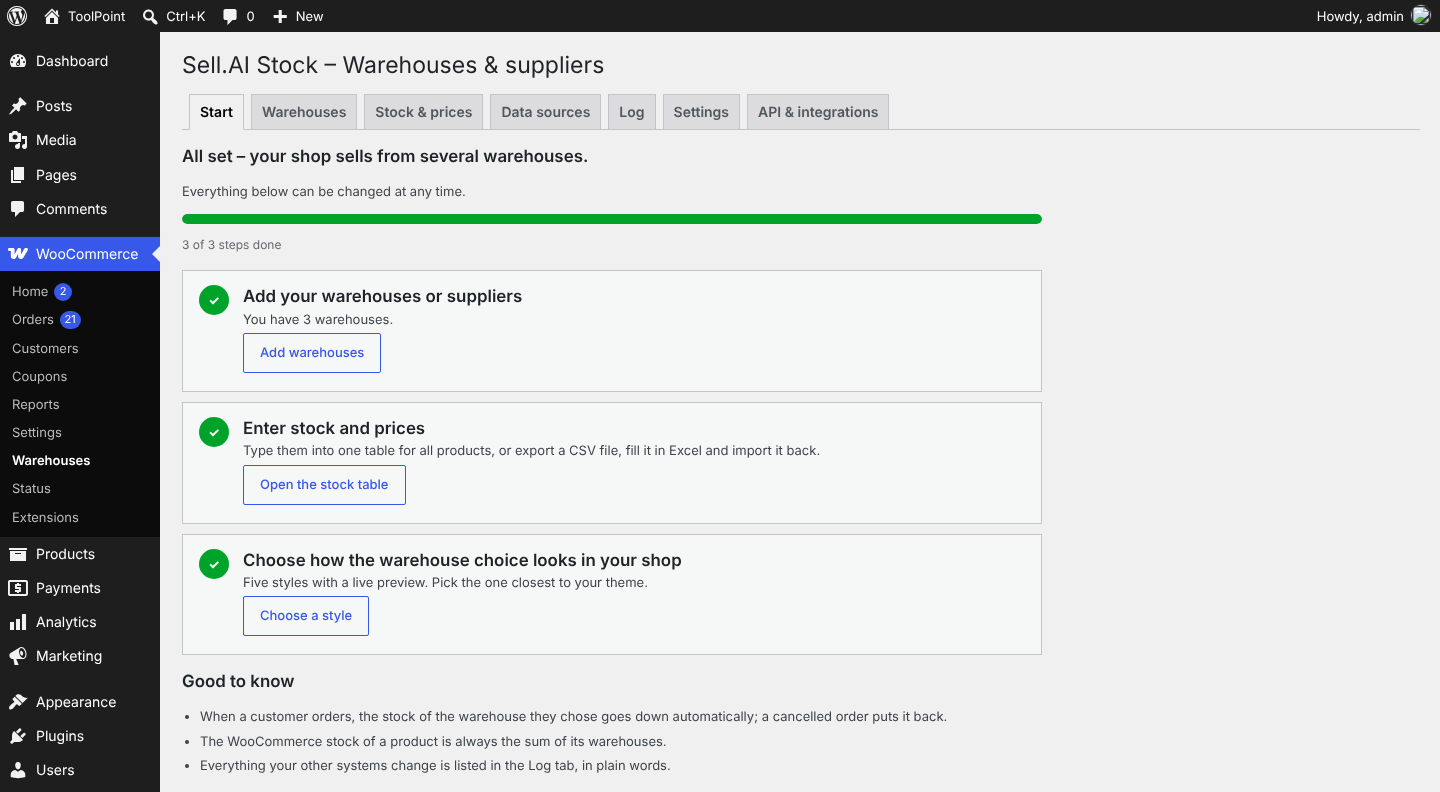
- Open WooCommerce Warehouses Start here and follow the four steps: add warehouses (just names), enter stock and prices (table or CSV), choose the look, and optionally connect Base or a wholesaler with the Pro add-on.
Perguntas frequentes
-
I already use the official Base integration. Do I have to switch it off?
-
No. With the Sell.AI Stock Pro add-on, choose under Settings “Another integration updates the WooCommerce stock” and the warehouse it belongs to: its stock becomes that warehouse and your other warehouses are added to the total. Without the add-on, products that use warehouses get their WooCommerce stock from the warehouses, so another integration should not write it.
-
Does it work with the block cart and checkout?
-
Yes. Prices, packages, validation and order data work the same way. A panel in the order summary lets customers change the warehouse of an item.
-
How does the API authenticate?
-
Generate a token in WooCommerce Warehouses API & integrations and send it in the
X-SellAI-Stock-Tokenheader (orAuthorization: Bearer). The token is stored only as a hash. Requests without valid credentials are rejected. -
Does it need WP-Cron?
-
Only to clean the data exchange log once a day. Scheduled updates from Base or wholesalers (Pro add-on) can also run from a system cron.
Avaliações
Não há avaliações para este plugin.
Colaboradores e desenvolvedores
“Sell.AI Stock – Multi-Warehouse & Suppliers for WooCommerce” é um programa de código aberto. As seguintes pessoas contribuíram para este plugin.
Colaboradores
Traduzir o “Sell.AI Stock – Multi-Warehouse & Suppliers for WooCommerce” para seu idioma.
Interessado no desenvolvimento?
Navegue pelo código, consulte o repositório SVN ou assine o registro de desenvolvimento por RSS.
Registro de alterações
2.0.0
- The Base (Baselinker) connector, wholesaler files (data sources), the compatibility mode for another stock integration and webhooks moved to the new Sell.AI Stock Pro add-on. Their settings and sources are kept: install the add-on to use them again.
- Without the add-on, the “Data sources” tab explains what it does.
- New extension points for add-ons: tabs, settings rows, Start steps, log channels and hints, API endpoint list.
- Translations are delivered by translate.wordpress.org; the setup reminder shows only on the Plugins screen.
- Tested with WordPress 7.1 and WooCommerce 11.2. Database queries use identifier placeholders; small layout fix for the filters of the stock table.
1.9.2
- Compatibility mode also catches integrations that set the stock with the WooCommerce stock function (wc_update_product_stock) instead of saving the product. Requests that change the stock of an order are never mistaken for such a write.
1.9.1
- Compatibility mode: when the integration sends the same stock the warehouse already has, the shop now keeps showing the total of all warehouses (before, it was left at the integration’s value).
1.9.0
- Compatibility mode (Settings “Another integration updates the WooCommerce stock”): keep the official Base integration or another plugin that writes the WooCommerce stock. Switching it on copies the current stock to the chosen warehouse; stock written later by the integration goes to that warehouse and the shop shows the total of all warehouses. Changes made by a person in the WooCommerce admin are treated as changes of the total. Orders work as before. All changes from outside are listed in the Log.
- The Settings tab now shows its “Settings saved” messages.
1.8.1
- The data source wizard offers a wholesaler file link and Base (Baselinker). The ERP connection is marked “Coming soon” until it is tested on real ERP systems; sources created earlier keep working.
1.8.0
- Base (Baselinker) connector: paste the API token, click “Connect to Base”, choose the catalog and pick from lists where each Base warehouse and price group goes in the shop. Products and variants are matched by SKU or EAN; several Base warehouses can be added up into one.
- Warnings for a price group in another currency, and automatic VAT removal when the shop enters prices without tax.
- Plain hints in the log for a rejected Base token and the Base request limit.
1.7.0
- “Start here” checklist with a progress bar (warehouses stock look connect a system) and a dashboard reminder until the setup is done.
- Warehouses need only a name: the code is made from it automatically and shown only on request.
- New data source starts with a choice: “a file link from a wholesaler” (just paste the link; login fields appear only when the link needs them) or “an ERP with an API” (full form).
- Warning with step-by-step Plesk / cPanel instructions when scheduled updates do not run on the server.
- “?” explanations next to the less obvious fields; developer tabs and theme selectors are hidden until needed.
1.6.1
- Security: requests into the local network (data source option) can only be enabled by administrators.
- CSV upload uses the standard WordPress upload handling.
- Readme: external services section, shorter summary.
1.6.0
- Data exchange log (new “Log” tab): every data source run, API sync and CSV import in plain language – what changed product by product, problems with a hint what to do, codes not found in the shop; filters, product history search and a box in the product editor. Kept 30 days by default (configurable).
- Simpler field mapping: “Fetch an example product” shows one product as a table with real values and a “What is it?” choice per field; the product list and the product code are found automatically.
- Mapping cards with a plain sentence and a worked example; options named for shop owners (reserve, maximum, net price + VAT, markup %, rounding, minimum price). The raw data tree stays available for advanced users.
1.5.0
- Data sources rebuilt around field rules: “source field WooCommerce target” with targets warehouse stock / price, WooCommerce stock quantity, regular price, sale price and custom fields.
- Field picker: fetch a sample and click the fields in a tree; paths with list filters (
stocks[store=W1].qty), sums ([*],a + b) and conditions. - Adjustments: safety stock, maximum, “below N show 0”, multiplier, amount, net gross VAT, rounding (.99 / .90 / whole), minimum price.
- XML and CSV sources (attributes, prefixed tags, Windows-1250), authorisation types with an encrypted secret, local network option.
- Matching by GTIN / EAN in batches; products not found in the shop are listed.
- Test shows every change (now from the source) before anything is saved; each run stores its result.
- Large sources are applied in the background (Action Scheduler); schedules every 15 minutes, hourly or daily.
- Sources created before keep working unchanged (“warehouses named by the source”).
1.4.2
- Deleting a warehouse from the registry now also removes its stock and price from all products and variations (with a confirmation), and the WooCommerce stock is recalculated. Leftovers of warehouses deleted earlier are cleaned up once after the update.
- New action
sellai_stock_warehouses_removed.
1.4.1
- Removed the Tools tab with a one-off data migration that only applied to a single site.
1.4.0
- CSV export and import of warehouse stock and prices on the “Stock & prices” tab: Excel-friendly format (semicolon + decimal comma, or comma + dot), preview with before/after values and errors, apply or cancel.
- WP-CLI:
wp sellai-stock export <file>andwp sellai-stock import <file> [--dry-run]. - Fix: the Polish translation file now also loads on WordPress 6.2–6.4 (legacy MO reader).
1.3.0
- New “Stock & prices” table for all products and variations.
- Prices accept both comma and dot as decimal separator (table and product editor).
1.2.0
- Universal connector: data sources (pull with field mapping, presets, pagination, dry-run test), outgoing signed webhooks with retry queue,
sellai_stockfield in the WooCommerce REST API, warehouse on order lines in /wc/v3/orders. - WP-CLI:
wp sellai-stock pull | webhooks retry | sync. - Fix: with “replace”, an omitted price now keeps the current warehouse price (as documented).
- Scheduled events are cleared on deactivation.
1.1.0
- Cart & Checkout blocks support (Store API extension, order summary panel).
- Warehouses for variations: editor table per variation and product page selector.
- 5 selector styles with live preview, corner setting.
- Warehouse stock follows wp-admin order edits, removed lines and refunds with restock; warehouse can be changed per order line; admin-added lines get a warehouse.
- Raw warehouse meta hidden in the order editor.
1.0.0
- First release.